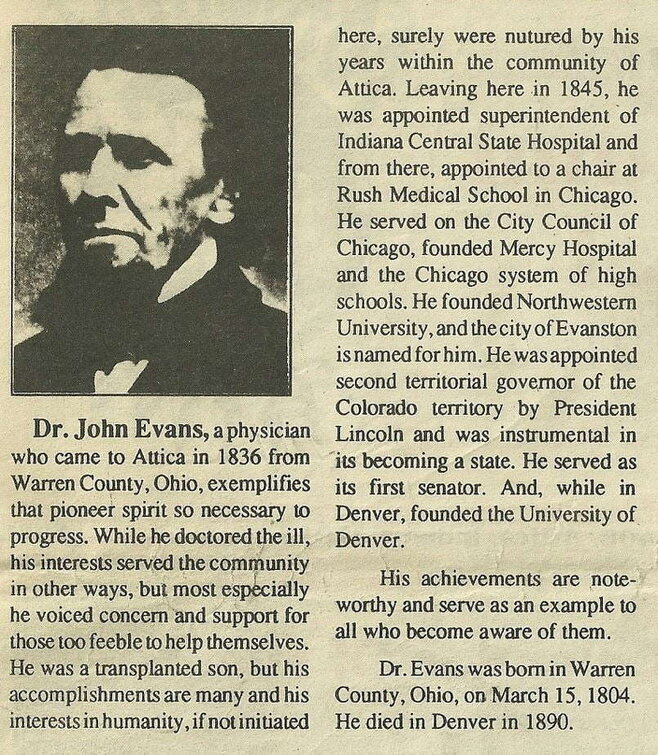





EVANS, John - Dr
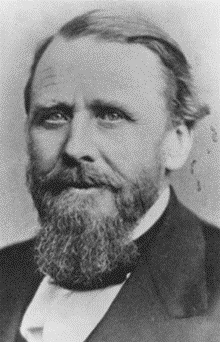
Dr. John Evans
Photo
from findagrave.com added by Fred Beisser
JOHN EVANS – politician; physician; professor; pioneer of the railroad system in Western US; founder of Indiana Hospital for the Insane; researcher (cholera) and wrote quarantine laws to ensure it not spreading; writer and the creator of Evanston, Illinois
You’ve heard people say, “I’m a jack of all trades but a master of none?” Not John Evans - he was the master of his whole being, a brilliant man not afraid to tackle something new and his list of interests and accomplishments shine as bright as this man! Evans was born into a fairly lucrative family on the 9th day of March in 1814 (Waynesville, Warren County, Ohio) and died on the 2nd of July 1897 (Denver Colorado) buried Riverside Cemetery there. His parents were David Evans and Rachel Burnett; they were the parents of ten children, John their first. At age 25, John married Hannah Canby. They settled in Attica from 1839-1845 where he practiced medicine and delved into other ventures. Sadly, Hannah passed away in 1850. Evans’ second wife was Margaret Patten Gray quite a few years younger than the good doctor. Altogether he fathered 5 sons and 2 daughters as far as I found anyway!
In 1845, he was a professor at Rush Medical College in Chicago which took him through the next 11 years. Prominent in public affairs he worked diligently to promote Northwestern University one of the great Methodist Institutions of America. Evanston, Illinois is not the only place named for this man – add the city of Evans, Colorado and Mount Evans (14,000 foot mountain with the highest paved road in North America).
Where would you say he lived and made the best impression? Well, he has a historical marker in Attica listing him only living here for six years but oh my to begin a hospital for the insane (Indiana) is major impressive and he does indeed need that pat on the back and big thank you! https://www.hmdb.org/m.asp?m=9947 – historical marker!
Evans met Lincoln when the railman was running for president and likely even earlier perhaps during his years at Rush College or in the creating of Evanston along with Evans’ work as Colorado Territorial Governor appointed by Lincoln. Another plus for this man was that he promoted the railroad system in Colorado, aided in promoting the mines, and the agriculture.
So, when addressing John Evans which would you pick? Dr. Evans: Professor Evans; Researcher Evans; Governor Evans; Writer Evans could definitely be thrown in but he was an Entrepreneur (basically promoting Denver, Colorado from a small village to a grand city as well as serving on Denver University’s Board of Trustees for decades) giving large (100,000 for instance) endowments of his own and still there was a great deal more to this impressive fellow! Me? I’d just call him one rounded, wonderful go-getter who made his place in at least these states: Indiana; Illinois; Colorado – it would have been exciting in the times to know this man! –
Used: Articles at the time of his death; county histories; find-a-grave etc. --transcribed by kbz
The next summer, the couple moved to Attica and began working in his field. While here, he heard Rev. Matthew Simpson give a talk and then joined the Methodist Episcopal Church which he followed his whole life. (Maurer, Josef. Coloradoencyclopedia.org and thank them for the photo).
As a doctor, he and a Covington physician (Fisher), took upon the needed job of building an insane asylum in Fountain County, thus having been dubbed as the founder of the Indiana Hospital for the Insane (Historical Marker, Attica), the hospital remaining in Fountain for several years. He became the first superintendent, holding that position the first couple of years, then was wooed to Rush College as a professor there. Chicago was in its boom time and Evans quite the mover and shaker. “Within a few years, he had helped establish the Chicago Medical Society, co-founded the Illinois General Hospital of the Lakes and edited a medical journal.” (Mauer). Next he got into the railroad business, helping to start the Ft. Wayne and Chicago rr. He delved into heart of the city real estate as well and became quite wealthy. From 1853-55 he served as an alderman for Chicago (Mauer). Education was important to the man and he then worked on founding Northwestern University, helping to draft its charter and select its first president. Plus, he served on the first board of trustees. (Mauer)
So, his professional life was forwarding even to the point he could quit his profession but his personal one was sad, having had four children with Hannah, but only one, Josephine survived to adulthood, and in 1850 Hannah died from consumption. He did marry again to Margaret Gray, the sister-in-law of one of Northwestern’s trustees. In 1855, when the University opened its doors, he built a large new home just south of the campus. ( Mauer)
A natural into politics with all his connections, he became acquainted with Lincoln and when Abe was elected, Evans made it known that he would be interested and successful in an appointment as governor of a western territory. William Gilpin, territorial governor of Colorado was ousted from office for “authorizing military payments without approval,” (Mauer) thus making a place for Evans.
The new place was just awaiting his leadership as he had had experience in real estate and railroads which he went to work developing, as well the Colorado Seminary (later to become the University of Denver). Also, he was quite a worker in promoting statehood. A minus where he was concerned however is what to do with the existing Indians who relied on the ranges for food and shelter. Many coming west planned on that, as well. Evans “relied on the existing framework of federal Indian policy which involved making treaties to acquire Indian land for white settlement, his primary goal was to gain wider Indian support to gather lands. A small group of Arapaho and Cheyenne chiefs had ceded their claims to most of the eastern plains and to forge new treaties with the Utes in the mountains. Evans diligently pursued these diplomatic solutions throughout 1862-663. Very sadly, things weren’t going well with the Native Americans. Then his attitude changed and he authorized a regiment of 100=day volunteers (3rd Colorado Cavalry) issuing Coloradans the option to kill and destroy the enemies of the country or any hostile Indians. This resulted in the Sand Creek massacre which of course killed as many women and children and older people than warriors. Although Major John Chivington came back to Denver in triumph, the news did not go well in Washington. “Evans distanced himself from the massacre and denied knowledge of it,” (Mauer) but the taint did follow him for the rest of his life, although he still remained fairly well loved and admired. He continued to live in Denver and developed the railroad systems, remaining as the higher crust of the city.
John Evans’ three children went forth and prospered as well. Josephine married Sam Elbert who served under Evans as secretary of Colorado Territory and would eventually become the territorial governor. William Gray Evans went into the railroad development with his father and the youngest of the three children to survive was quite the cultural guru of Denver playing roles in developing the art museum; library and opera. At age 83, he passed away in Denver and the impression he made upon the place was reflected in the city of Evans; Evans Avenue in Denver and Mt. Evans, as well (Maurer).