





EVANS, Dr. John
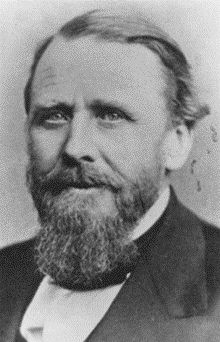
Dr. John Evans
Photo from findagrave.com added by Fred Beisser
Source: Princeton Clarion-Leader Thursday Aug 5, 1897 p 6
No man had more to do with the growth and development of Colorado than ex-Governor John Evans, who died recently at his Denver home. An Ohioan by birth – he was born in 1814 – he had unusual advantages for his day, his father being wealthy. He selected medicine for his profession and in 1836 began practice among the pioneers of Illinois. Three years later he went to Indiana and in 1845 became a professor in Rush Medical College in Chicago. There he remained 11 years. He was prominent in public affairs and it was his work that led to the founding of the great Methodist institution, the Northwestern University at Evanston. The latter town – now one of the handsomest suburbs of Chicago – he founded and it very properly bears his name. He was not content with being the author of the plan out of which the university grew. He endowed from his private wealth the chairs of Latin and of mental and moral philosophy in the amount of $50,000 and later increased that fund to $100,000. He was the first chairman of the Board of Trustees and occupied that position for 42 years. He was one of the first to advocate the emancipation of the slaves. He voted for the nomination of Abraham Lincon at the convention of 1860 and was soon after sent by the President to Colorado to fill the place of Gov. Gilpin. His career in Colorado since that time has been a part of the history of the territory and the State in its march forward. He helped the building of her railroads, the development of her mines, her agriculture and the general growth of her commonwealth in a manner unparallelled by any one of her citizens. --transcribed by kbz
Source: The Indianapolis Journal Sunday 4 July 1897 p 4
Denver, Col July 3 – John Evans, ex-Governor of Colorado died at 4:30 o’clock this afternoon, aged 83. The cause of death was a general break-down due to old age. For the past two years Governor Evans has been rapidly sinking, having lost the power of speech. John Evans was born in Waynesville, Ohio March 9, 1814 and was always noted for a vigorous mentality. He was a pioneer of Chicago and laid the foundation of the Northwestern University at Evanston, Ill which was named for him and practically established the public school system there, fighting in the Council of which he was a member for large funds to carry out his plans. In Chicago he promoted the construction of the Fort Wayne Railway and it was due to his personal activity that the line was completed. Going to Denver he manifested the same energy that characterized him in the East and built the first Methodist Church of any pretensions. He also endowed the University of Denver patterned after the Northwestern and became an active railroad promoter, being interested in the construction of the Kansas Pacific and later the Denver & Fort Worth Railway and the Denver, Leadville & Gunnison Railway. Four years ago the venerable financier actually understood the organization of an air-line railroad from Denver to El Paso, Tex but his health prevents its final organization. Within the past 8 years he constructed one of the most perfect systems of electric railways in the country in Denver – his last great work. When the Pacific roads were built Denver was left off the line. Mr. Evans around the people and the connecting line from the Union Pacific to Denver was constructed practically through his efforts. Mr. Evans was one of the delegates to the convention which nominated Abraham Lincoln for the president of the United States and was one of the “railsplitter’s most loyal supporters.” The position of Governor of Washington Territory was tendered to him when Mr. Lincoln assumed the reins of state but he declined. The appointment of Governor of the Territory of Colorado was more acceptable and thither he went in 1861. He remained at the head of affairs until President Johnson came into control and he was removed through false stories circulated by his enemies. Mr. Evans was twice elected US senator from Colorado but President Johnson nullified the election by vetoing the bill making Colorado a state. Evanston’s name came about in a singular way. Mr. Evans and his friend Bishop Simpson went to the place in 1848 and found only a few cottages and thatched houses. Mr. Evans insisted that the village should bear the divine’s name and the latter was equally determined to honor his companion. Evanston was finally agreed on as the name and it has borne it ever since. The story of how Dr. Evans became a Methodist is equally interesting. He had been a Quaker by birth and his early impressions had served to make him theoretical in holy things. When he met Bishop Simpson he was so impressed by his words that he immediately joined his church. Dr. Evans’ devotion to his relation and his zeal in its cause have helped it in the West. He founded Denver University with a donation of $100,000 and contributed largely to other institutions of the Methodist Creed. Mr. Evans was a resident of Indiana over a century ago. On the 13th of January 1845, he, together with Dr. Livingston Dunlap and James Blake were appointed commissioners to obtain a site for an insane hospital, containing not to exceed 200 acres. They selected a farm at Mount Jackson, the home of Nathaniel and Sarah T. Bolton, the poetess. The first building was begun in 1846 and finished the following year at a cost of $75,000. This has been added to from time to time until the amount invested in building of the Central Hospital for the Insane is nearly a million dollars. --transcribed by kbz